Canada Contract Security Program: How Suppliers Get Security Screening for Government Contracts
BidClarity Editorial Team · Reviewed against official sources on
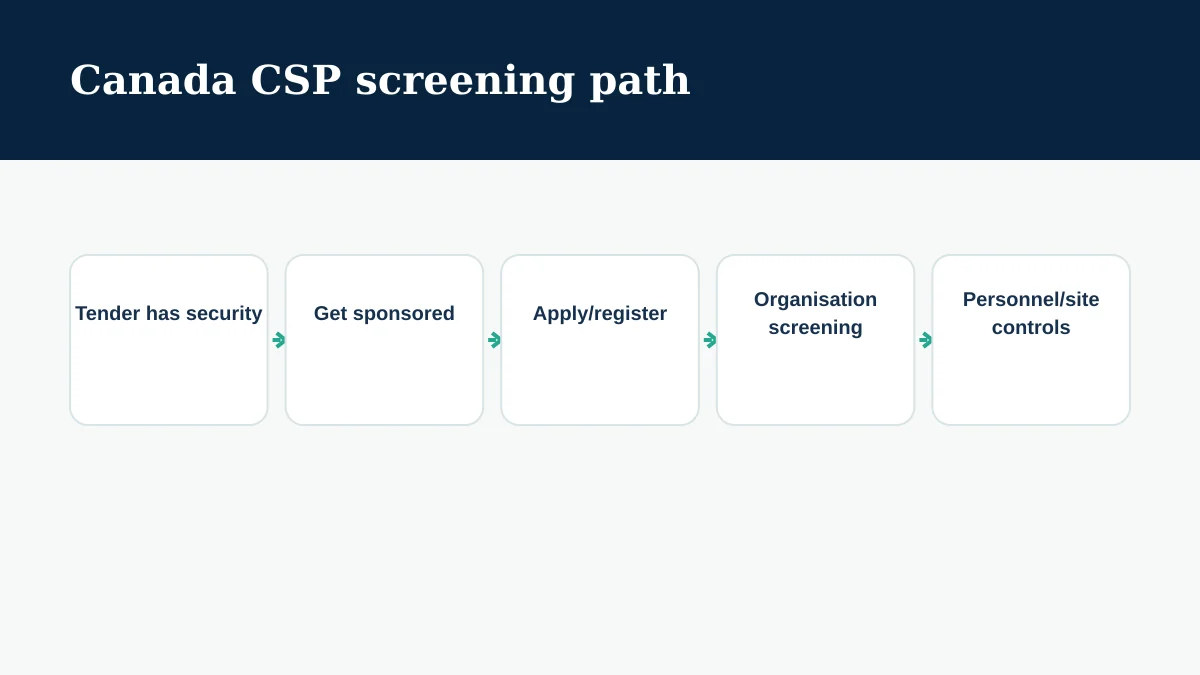
Quick answer: If a Government of Canada contract has security requirements, the supplier organization must be screened through Public Services and Procurement Canada's (PSPC) Contract Security Program (CSP). The organization must first be sponsored; it cannot sponsor itself or ask to be cleared in advance. Depending on the contract, it needs a provisional security clearance, a Designated Organization Screening (DOS) or a Facility Security Clearance (FSC).
Key facts
- Program: PSPC's Contract Security Program.
- When it applies: bidding on or working on government contracts with security requirements.
- Sponsorship: required first. Organizations cannot sponsor themselves.
- Organization screening: provisional clearance (for bid preparation), DOS (protected level), FSC (classified level).
- PSPC's estimated times: DOS up to 4 months; FSC 6 months or more; provisional clearance varies by level.
In this guide
When does a supplier need the Contract Security Program?
The CSP screens eligible organizations that are bidding on or working on government contracts with security requirements: access to protected or classified information or assets, or to restricted sites.
The requirement is stated in the solicitation, usually in a Security Requirements Check List (SRCL) and the security clauses that come with it. Not every federal contract needs screening. If the solicitation needs a clearance during bid preparation, do not wait for award.
Why sponsorship comes first
PSPC says that to be screened by the CSP, your organization must first be sponsored. Sponsors are federal government officials, such as procurement or security officers, or the security officer of a cleared organization in good standing.
Organizations cannot sponsor themselves and cannot ask for a pre-clearance. Screening is tied to a real contracting need, not something to get ahead of time for marketing.
Provisional clearance, DOS and FSC
PSPC screens organizations at the level the contract needs. The solicitation's SRCL and security clauses decide which one you need.
| Type | What it is for | PSPC's estimated time |
|---|---|---|
| Provisional security clearance | Access to protected or classified information or assets during pre-solicitation or bid preparation, if you do not already hold the level needed | Varies by level |
| Designated Organization Screening (DOS) | Contracts at the protected level | Up to 4 months |
| Facility Security Clearance (FSC) | Contracts at the classified level | 6 months or more |
What the application asks for
The CSP's Application for Registration asks about your organization's structure, ownership and legal status. Personnel screening forms are also needed for the company security officer, sole proprietors or partners, and individual owners, officers, directors or managing partners the CSP asks for.
Have accurate corporate and ownership records ready before you start. Use your legal name and keep the details consistent everywhere.
Organization screening may not be the end
A contract can also require screening for the people who do the work, a company security officer, secure work sites, and controls for storing documents.
"We have organization screening" is only one part of the requirement. Map each security clause in the solicitation to the people, systems and sites it affects.
Screening is not the same as cyber security certification. If you sell into defence, also read our guide to CPCSC Level 1.
What foreign suppliers should know
PSPC publishes separate guidance on international contract security requirements. It covers foreign organizations bidding on Government of Canada contracts, and Canadian organizations contracting with foreign governments.
If your opportunity crosses a border, follow that guidance and the solicitation's security clauses. Do not assume a clearance from one country carries over to the other.
Practical checklist
- Find the SRCL and security clauses in the solicitation.
- Identify the organization screening level required.
- Confirm who will sponsor you.
- Prepare ownership, officer and director records.
- Name your company security officer.
- Track the personnel screening each role needs.
- Check the site and document safeguarding requirements.
- Allow for PSPC's estimated screening times when you plan the bid.
Where BidClarity fits
BidClarity helps suppliers decide which public sector opportunities are worth pursuing. Security screening remains PSPC's process, and the solicitation's security clauses decide what you need.
To see which procurement sources BidClarity reads, and the status of each, see Procurement Sources.
See which open opportunities fit your company, and why.
Common questions
Can I get screened before I have a contract opportunity?
No. Your organization must be sponsored, and PSPC says organizations cannot request a pre-clearance under any circumstance.
What is the difference between DOS and FSC?
DOS is for contracts at the protected level. FSC is for contracts at the classified level. The solicitation says which one applies.
Does every employee need screening?
Not necessarily. It depends on what each person needs to access under the contract.
Related guides
Official sources
- PSPC: About organization security screening
- PSPC: Obtain a security screening for your organization
- PSPC: Sponsorship process
- Treasury Board: Security Requirements Check List (SRCL) form
- PSPC: International contract security requirements
This guide is general information, not legal or procurement advice. The solicitation and the official sources control. If something here no longer matches them, report a correction.