Standing Offer vs Supply Arrangement in Canada: A Supplier's Guide
BidClarity Editorial Team · Reviewed against official sources on
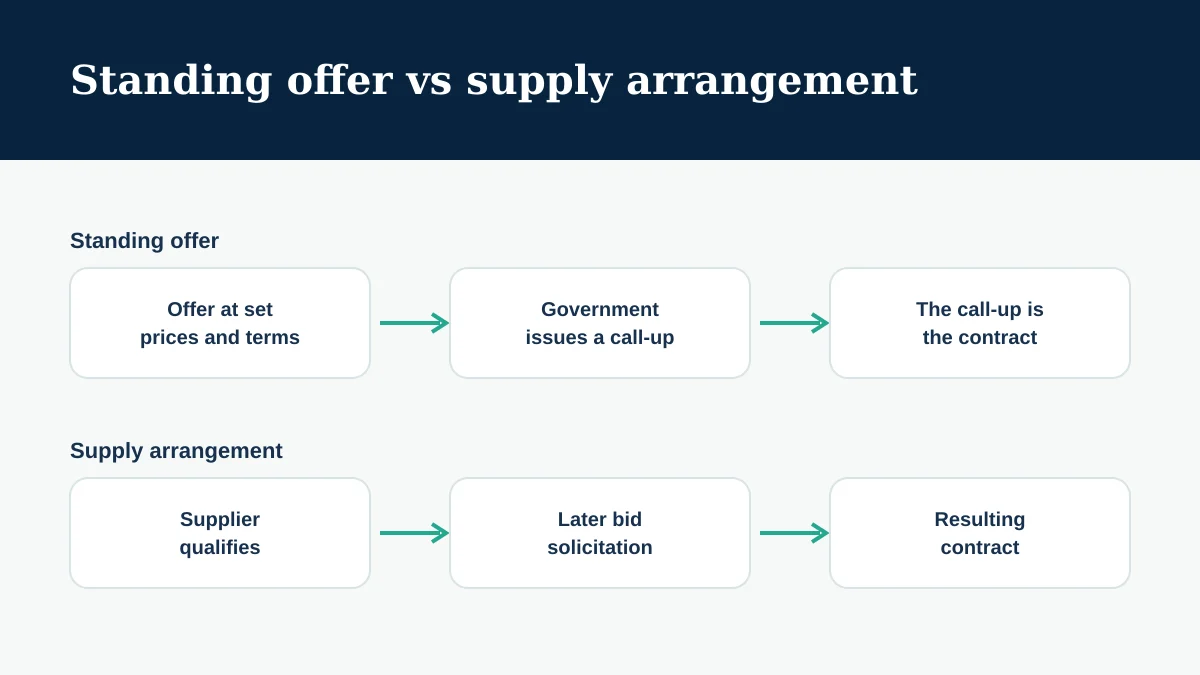
Quick answer: A Government of Canada standing offer is a supplier's offer to provide goods or services at pre-arranged prices and terms. It is not a contract: a contract exists only when the government issues a call-up against it. A supply arrangement sets predetermined conditions for later bid solicitations among qualified suppliers. It is not a contract either. Holding either one does not guarantee any purchase.
Key facts
- Standing offer: not a contract. A call-up accepts the offer and becomes the contract.
- Supply arrangement: not a contract. It sets the conditions for later bid solicitations and the contracts that result.
- More than one supplier: a standing offer can be arranged with several suppliers for the same goods or services.
- Guaranteed spend: neither one, on its own.
- Official source: CanadaBuys, run by Public Services and Procurement Canada (PSPC).
In this guide
What is a standing offer?
CanadaBuys defines a standing offer as an offer from a potential supplier to provide goods or services at pre-arranged prices, under set terms and conditions. It is not a contract. When the government issues a call-up, the call-up accepts the offer and becomes legally binding, and it tells you to deliver.
That matters when you forecast. A standing offer gives the government a way to buy from you. It does not mean anything has been bought.
What is a supply arrangement?
A supply arrangement is a method of supply PSPC uses to buy goods and services. It sets predetermined conditions that apply to later bid solicitations and the contracts that result. Signing one does not legally bind either party.
When a need arises, PSPC or the client department runs a solicitation among the qualified suppliers and prepares the contract within the arrangement's scope. For you, qualifying is the right to compete for later work, not the work itself.
Standing offer vs supply arrangement: the supplier view
Use the instrument to plan your next step, not as the finish line.
| Question | Standing offer | Supply arrangement |
|---|---|---|
| Is it a contract? | No | No |
| What creates the work? | A call-up | A later bid solicitation and the resulting contract |
| Are prices and terms set in advance? | Yes | Conditions are set; each requirement is competed |
| Does qualifying guarantee spend? | No | No |
| Your focus afterwards | Being called up, and performing | Competing in each solicitation, and staying qualified |
Why qualifying changes your pipeline
Once you hold a standing offer or a supply arrangement, a general tender search is no longer enough. Learn how call-ups or competitions are run, which departments can use the instrument, which categories or streams you hold, and when it is refreshed.
This matters most for professional services. PSPC's professional-services supply arrangements, such as Task and Solutions Professional Services (TSPS) and ProServices, are organized into streams and categories and are refreshed on a schedule. PSPC publishes the refresh and re-competition schedule; a refresh is when suppliers can qualify or update their arrangement.
Can you lose opportunities after qualifying?
Yes. You can be qualified and still not be called up or chosen in a later competition. Capability, price, category, location, security requirements and the buyer's own criteria still decide each one.
Treat the instrument as access to a market, not as orders you can count on.
What to do after you qualify
Write a short playbook for each instrument: which departments can use it, which categories you hold, any maximum call-up value, how opportunities reach you, who answers them, and when the next refresh or re-competition is.
Then measure the call-ups and competitions you actually see, not the number of instruments you hold.
Practical checklist
- Record the exact instrument and its number.
- Save your categories, streams and geographic scope.
- Learn the call-up or competition rules.
- Track refresh and re-competition dates.
- Check any security requirements.
- Name an owner for each competition.
- Track call-ups and contracts won separately from qualifications held.
Where BidClarity fits
BidClarity helps suppliers decide which public sector opportunities are worth pursuing. Access to a standing offer or supply arrangement, and every call-up under it, is governed by the instrument's own rules.
To see which procurement sources BidClarity reads, and the status of each, see Procurement Sources.
See which open opportunities fit your company, and why.
Common questions
Is a standing offer a contract?
No. CanadaBuys says so directly. A call-up against the standing offer is the contract.
Does a supply arrangement guarantee work?
No. It sets the conditions under which qualified suppliers compete for later requirements.
Can more than one supplier hold the same standing offer?
Yes. CanadaBuys notes that standing offers can be arranged with more than one supplier for the same goods or services.
Related guides
Official sources
- CanadaBuys: Standing offers and supply arrangements
- PSPC: Task and Solutions Professional Services, guidance for suppliers
- PSPC: ProServices, guidance for suppliers
This guide is general information, not legal or procurement advice. The solicitation and the official sources control. If something here no longer matches them, report a correction.